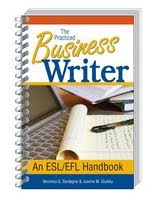
The Practiced Business Writer

Kenneth Beare from ESL.About.com has reviewed The Practiced Business Writer--the book I co-authored with Joanne Slutsky. Please take a look at the review here.

You can find some other reviews at Amazon.com.

If you've seen our book, or are using it for instruction or learning, we'd like to hear from you, too!

E-Portfolios

Electronic portfolios allow students to reflect on their learning process, make connections, revisit learning experiences, and share their accomplishments. Consider using electronic portfolios in your courses.

My students in a Methods Course for Second/Foreign Language Teachers designed their own e-portfolios for the course. They all reflected very positively on this experience. If you want to have a look at their work, read their reflections and lesson plans, and get access to very useful lists of online resources for their particular teaching contexts, please go to this post in our Class Blog:

TEACH l2: Online Resources for Language Teachers

Russian Webcasts, Videos, and Audio

Visit these websites for authentic and simplified Russian webcasts, videos, and audios for language learners of Russian.
  • NCRLC Russian Webcasts
    This website casts the news in simplified standard Russian.
  • RussianLessons.net
    This website presents articles in both Russian and English. These articles are designed for advanced language learners of Russian.
  • Polyglot Videos
    In this website, you'll find selected Russian videos from YouTube for beginner, intermediate and advanced learners of Russian.
  • Listen2Russian.com
    This website has audio files for language learners of Russian. Here you can hear and practice Russian words, phrases, and sounds.

Songs for Teaching

Songs are an excellent resource for language activities. They promote listening comprehension in a fun way. Here are some of my favorite sites for working with songs.

Songs for Teaching has a wonderful collection of lyrics (most with audio files) that can be used to teach a variety of topics to learners of all ages. This website also has a specific section that groups songs according to their target language:
  • If you are looking for Spanish songs, click here and here.
  • If you are looking for French songs, click here.
  • If you are looking for German songs, click here.
  • If you are looking for ESL/EFL/ESOL songs, click here.
  • IF you are looking for Chinese songs, click here.

If you are looking for songs that promote literacy, then here are some suggestions:

Other sites for working with songs with young learners in the ESL/EFL class are:
If you are looking for already-made activities for songs, then go to Songs from ToLearnEnglish.com. Most of the lyrics come with audio and interesting activities. You can even create your own activity and post it here. Because the contributions come from anybody who wishes to contribute, some activities are not that good. Yet, this website is a valuable resource for creative ideas and songs.

Also, check out this blog (Using songs for Teaching). It has some great ideas for using songs in the language classroom.

Bilingual Sites for Families and Educators of English Language Learners

There are many sites out there for bilingual students. The following are the ones I recommend:
  • ColorinColorado.org
    This website is full of resources for teachers of bilingual kids with educational videos, web resources, and many more. If you are a teacher in this context, be sure to check out the webcasts, free guides and tool kits. This site is supported by the American Association of Teachers (AFT). It is a must see for any bilingual teacher.
  • MisCositas.com
    This website has a huge collection of picturebooks in English, French, Chinese, Italian, and Spanish. It has curricular suggestions for teaching and learning these languages and links to more multilingual resources. This site is wonderful for kids.
  • StarFall.com
    This is a great site for pre-K ELLs. It contains activities, games, and stories that encourage beginning literacy skills.
  • Media in Portuguese

    These are links to newspapers and magazines written in Portuguese.
    • Expresso
      This is the largest weekly newspaper in Portugal
    • Folha Online
      News from São Paolo.
    • Pagina Inicial
      News from Porto.
    • Publico
      News in Portuguese on what's going on in Portugal and other European countries.

    Portuguese Literature

    If you are looking for good readers for the Portuguese language class or for your own self study, don't look any more. You can find anything you want in these two amazing sites:

  • Portuguese Literature
    Find here a link to a variety of Portuguese online texts, poems and music.
  • Literatura Brasileira
    This website offers links to information on authors and works by century. It takes a few links to get to the good stuff, but trust me you'll find good resources here.
  • ESL and Business Writing Blogs

    These blogs are a wonderful way to get updated with what is going on in the fields of business and ESL writing. They are also good resources for the language class as many include great writing tips for our students.

    Check them out.


    Business Writing Blogs:


    Other Popular Writing Blogs:


    ESL Blogs:


    Live Podcasts in Russian

    These websites are well beyond my expertise. The podcasts are said to be in Russian, and I believe they are, but I can't understand a word. Therefore, I cannot assess their quality. I hope teachers and students of Russian find them useful.

    Websites with Lots of Resources for Portuguese Language Learners

    These websites offer numerous links to useful resources for those interested in studying the Portuguese language.
    • Brazilian Portuguese Grammar
      This website is for English speakers who want to speak Portuguese. It offers good information, and grammar, sounds and vocabulary practice. It also provides tons of links to other websites for Portuguese language learners. It's a must for any language teacher of Portuguese!
    • SoniaPortuguese.com
      This website has a huge number of links for people interested in Brazil. Not all is good, but some of the links are good resources for reading, and discussion activities. Also, some of the links offer other very useful links to other websites.
    • Sapo.pt
      This website has links to videos and blogs in Portuguese. It also serves as a search engine to all Portuguese-related websites. What you cannot find with google, you'll surely find it here!
    It is a matter of looking at these resources and finding one that suits your needs. There is plenty for the language class. I hope you find here what you need.

    Creative Ideas for the Spanish Class

    Look at these websites for creative ideas for the Spanish class:

    • Primary Resources
      This site has worksheets and creative games to use in the primary classroom
    • StudySpanish.com
      This is a free online site that lets Spanish language learners study a variety of terms, access tutorials, drills, vocabulary and pronunciation practice, idioms, and much more.
    • Miscositas.com
      This site has a collection of virtual picturebooks in English, French and Spanish. Also includes games, realia, and curricular recommendations for class instruction. It also has links to other resources.
    • La biblioteca escolar
      This site has plenty of digital stories in Spanish.
    • Spanish Tongue Twisters
      This is a wonderful site to practice sounds in Spanish. It lists many tongue twisters that can be used for fun in the language classroom.

    Using Wikis for Instruction

    Wikis are wonderful tools for collaboration, sharing, and written group work activities.

    This video explains Wikis in Plain English


    Free wikis spaces for classroom use:
    pbworks.com
    wet paint.com
    wikispaces.com

    Using Blogs for Instruction

    Blogs are useful for logging ideas, creating discussions, recording reactions, sharing information, and reflecting.

    This video explains what blogging means in Plain English.


    You can use any of the following free sites for blogging with your students:

    Sites Rated by Popularity

    Consult these sites to find the most popular sites for teachers, students, children, and ESL learners.
    • SitesforTeachers.com
      This website lists hundreds of educational websites rated by popularity including lesson plans, clip art, activities, worksheets, and much more. Read the descriptions for each website to identify those you might want to check out.
    • SitesforParents.com
      This website lists hundreds of educational websites for parents rated by popularity. It also contains descriptions for each of the listed websites.
    • Ultimate Top 100 Kids Sites
      This website lists top 100 sites for children, teens, parents and teachers. It includes games, educational activities, coloring, poetry, stories, clip art, and much more.
    • Top ESL Sites
      This website lists ESL sites rated by popularity. It also contains descriptions for each of the listed websites.

    Suggested Activities

    1. Conduct your own searches to find the resources you need.
    2. Design a webquest for students or student teachers. You can ask them to identify, describe and rate a number of good resources
      (a) for a specific language skill (listening, reading, etc.),
      (b) with a specific format (clip art, printables, audio, video, etc.),
      (c) for a particular audience (teachers, students, adults, children, parents, etc.),
      (d) for home practice or class practice.
      Also consider asking them to explain why they recommend using these resources and say how they would use them for practice and/or teaching.

    Speaking Resources for French Language Learners

    These sites offer plenty of resources that help improve students' speaking skills and strategies.
    • French Listening and Speaking Central
      This site offers tons of links for listening and speaking activities for French language learners
    • French.about.com
      This link takes you to information and other links that offer practice to improve French students' pronunciation.
    • French for Work
      This site offers video clips and phrase files designed to improve students' speaking abilities at the workplace.
    Suggested Activities
    1. Ask students to view these sites, listen to the video clips and jot down useful expressions.
    2. Ask students to learn/practice the sound system of French.
    3. Ask student to repeat phrases/words after they hear them in the exercises.

    Picture Dictionary and Translation Sites

    Among the many dictionary resources out there, I found these two particularly helpful for learners of different languages:
    • Pdictionary.com
      Pdictionary.com is a free, online multilingual picture dictionary for beginning English, French, German, Spanish and Italian language learners of all ages. It includes activities to correct misspellings, and unscramble letters to form the correct word.
    • Alta Vista Translation Service
      This site offers a free translation service. Just submit a text or a URL for a webpage and this tool will translate it from English to Spanish, French, Portuguese, German, Italian, Dutch and many more, and viceversa. Just click and get an instant understandable translation.

    Suggested Activities
    1. Make the picture dictionary available to young learners during lab activities. Ask them to look up difficult vocabulary words and then provide sentences using those words, a definition of the word, or a translation. Alternatively, you can assign these activities for homework.
    2. Teachers can use the translation service to help bilingual learners who lack the resources to speak in the L2. It is a quick way to get to know what a student wants to say and teach him/her the right word. Teachers can use this resource after trying to elicit the word from the student in other ways: e.g., with an example, a definition, a paraphrase, and the like.


    Cool Videos for Language Learners

    Visit yappr.com and have lots of fun.

    This site has many cool videos uploaded by other language learners or teachers. These videos are wonderful resources for language learning. Most have a script that you can use to check your ability to understand the words you hear. If you are a teacher, you'll be thrilled by all the activities you can prepare based on these videos.

    You can become a member and upload your own videos, share videos with others, translate the script for others, chat with others and become friends, and much more.

    Suggested Activities
    1. Become a member and save your favorite videos. You can listen to these videos whenever you want to polish up your English, or to improve your vocabulary and/or listening comprehension skills.
    2. Upload your own video clip and provide a script for other language learners.
    3. Share your favorite videos with your classmates.
    4. Prepare activities for your students based on these videos. For example, you can ask your students to a) react to the content presented by the video clip, b) answer questions based on the video clip, c) provide a follow-up to a video clip either in writing (e.g., continue the script, narrate what happens afterwards), visually (e.g., make a video clip that continues the story presented), or orally (e.g., discuss how the video clip may continue, brainstorm different endings to the story presented).

    E-portfolios

    Colleges of Education in many campuses are implementing e-portfolios to showcase students’ work. E-portfolios are also an excellent tool to showcase personal academic and work experiences.

    These two websites have articles that define e-portfolios:
    • The Electronic Portfolio Boom: What’s it All About?
      This article, written by Trent Batson, defines e-portfolios, discusses the benefits and drawbacks of developing e-portfolios, and lists many useful e-portfolios tools and resources. Although it is a 2002 article, it is still possible to access most of the resources listed.
    • The Digital Convergence: Extending the Porfolio Model
      This article, written in 2004 by Gary Greenberg, describes different kinds of electronic portfolios (showcase, structured, and learning) and provides examples of university programs that use each type.
    These two other urls offer a collection of multiple resources on e-portfolios:
    • The Resources page from the ePort Consortium
      The ePort Consortium is an association of over 800 higher education and IT institutions in 68 countries interested in the development of academic ePortfolio software systems and standards. A resource link takes you to this url with an extensive collection to websites, articles, and e-portfolio projects.
    • Electronicportfolios.org
      This website, sponsored by Helen Barret, is rich with links to useful information on e-portfolios. The information includes publications, conference handouts, Internet sites, templates, development guides, exhibits, evaluation rubrics, examples, video and audio resources, and the like. There is also a link to Dr. Barret’s weblog devoted to her research and experiences with e-portfolios.
    Suggested Activities
    1. Use e-portfolios to showcase your students’ work.
    2. Use e-portfolios to show parents what their children do at school. Provide samples of their work.
    3. Use e-portfolios to reflect on your teaching practices and goals for a particular class or teaching in general.
    4. Ask student teachers to showcase their work and reflect on their teaching experiences. After they graduate, these students will probably need to create an e-portfolio for the institution they work. Hence, they will all find this activity useful for their future careers.

    Repository of Learning Objects

    Learning objects are web-based self contained activities that can be used across disciplines and for different learning purposes. The following repositories direct you to a number of learning objects that you can use for instructional purposes. You’ll surely find a web-based activity that suits your needs.

    • MERLOT – Multimedia Educational Resource for Learning and Online Teaching
      It houses the metadata and provides links to the home locations of learning objects in a wide array of disciplines.
    • Ed Cast – The Higher Education Podcast Repository
    • Wisc-Online – Wisconsin Online Resource Center
    • National Science Digital Library

    Ideas for Writing Speeches and Conducting Classroom Debates

    To make your students improve their oral skills, assign them a speech or make them participate in an oral debate.

    Consult the following learning objects for topic ideas and activities.

  • WebEnglishTeacher.com
    This website offers links to many different activities for debates and speeches.
  • SpeechTopicsHelp.com
    This website offers a comprehensive list of topics for speeches.
  • About.com
    This website offers tips for Effective Speech Writing in Education.